
Chronology
Between Padua and Venice
1592-1608
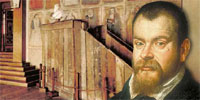

In 1592, unsatisfied by the conditions of his academic post in Pisa, Galileo requested and obtained from the Venetian Senate the Chair of Mathematics at the University of Padua. In the Venetian Republic he spent eighteen highly productive years, during which he carried out studies and experiments in mechanics and magnetism, invented the thermoscope, the forerunner of the modern thermometer, and designed and constructed the geometric and military compass, a versatile, sophisticated calculation instrument used to carry out numerous geometric and arithmetical operations. In 1594 he obtained a patent for a machine that, driven by the motive force of a horse, lifted water to be used for irrigating fields.
In 1597, in two letters, one addressed to Iacopo Mazzoni, his friend and former colleague at Pisa, and one to Johann Kepler, Galileo declared himself in favor of the Copernican system. In 1609 he perfected the telescope with which he carried out the observations that led him to discover many hitherto unknown celestial bodies.
From his relationship with a Venetian woman called Marina Gamba, of whom almost nothing is known, three children were born: two girls, Virginia and Livia, who both entered convents, under the names of Suor Maria Celeste and Suor Arcangela, and a boy, Vincenzo.